Squad Busters Characters Guide: The “Who Do I Build?” Cheat Sheet From a Player Who’s Been Burned Before
If you’ve played Squad Busters for more than, like, two sessions, you’ve already learned the painful truth: your squad isn’t “good” because you like the characters. Your squad is good because the characters work together, scale with evolution, and fit the world/map you’re in. The roster is a Supercell crossover buffet, and it’s super easy to build a squad that looks cool but gets deleted the moment a real PvP squad rolls up.
This guide is basically the “I wish someone told me this earlier” version of a Squad Busters characters breakdown—who’s strong, who’s overrated, who’s secretly good when you build around them, and how to think about roles/synergies instead of just chasing whatever feels flashy.
Also: Squad Busters is not static. The game’s progression revolves around evolving characters (Baby → Classic → Super → Ultra) and, later on, Ultimate upgrades via specific systems. That means a character that feels “meh” early can turn into a monster once you hit the right evolution breakpoint.
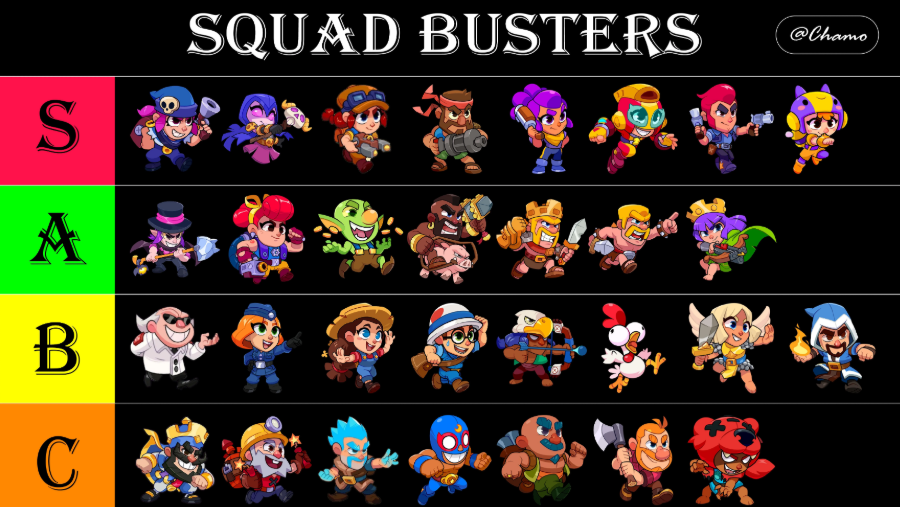
I. Introduction to Squad Busters Characters
A. Crossover roster vibes (and why it matters)
Squad Busters pulls characters across multiple Supercell universes—Clash, Brawl Stars, and more—so you get wildly different kits: aura-buff leaders, coin/gem economy units, burst assassins, heal stations, and straight-up “I win this fight” tempo picks. There are dozens of playable characters (commonly tracked community rosters sit in the mid-30s range).
The important part isn’t “who’s from what franchise.” It’s that characters tend to fall into repeatable gameplay roles that make squads click:
Leaders/Aura buffers (make a whole squad stronger)
Carries (convert your gold/choices into kills)
Frontline/Defenders (so your carries actually get to shoot)
Economy/Suppliers (so you hit power spikes earlier)
Healers/Sustain (so you don’t bleed out after one bad trade)
Speedsters/Rotators (win the map, not just the fight)
B. Progression: chests, events, evolutions, and why “time” beats “luck”
Your progression is basically: unlock units → evolve them → unlock better consistency → win more fights → unlock faster. Some systems can award higher evolution versions directly (for example, Star Chests can grant Classic/Super/Ultra and sometimes Ultimate evolutions for characters you already own).
So: even if you’re F2P, you’re not doomed. But you do need to invest smartly, because spreading upgrades across 15 characters is the fastest way to end up with 15 mediocre characters.
C. Why roles/worlds/synergy is the real “meta”
A character being “S-tier” doesn’t mean they’re always best. It usually means:
they’re strong in more than one world,
they’re good even when your draft is awkward, and
they scale hard with evolution.
That’s why the same few names keep showing up at the top of most serious squad discussions.
II. Character Rarity and Evolution System
A. Rarity basics (what you should actually care about)
Different community trackers describe rarity a bit differently, but the practical reality is:
Some characters are easier to get early (common-ish picks).
Some are “premium” or harder to acquire/upgrade (often your big power spikes).
Your evolution level matters more than the label on the box.
So when people argue about rarity, what they’re really arguing about is: how realistic it is to reach the evolution breakpoint that makes the character disgusting.
B. Evolution mechanics: Baby → Classic → Super → Ultra → Ultimate
The core evolution ladder you’ll see everywhere is: Baby → Classic → Super → Ultra.
And yes—Ultimate forms exist for at least some characters, and unlocking them is typically a longer-term grind (for example, community guides describe needing multiple Ultra copies to convert into an Ultimate form).
Practical takeaway:
Baby = “kit preview”
Classic = “now they’re a real unit”
Super = “this is where the kit starts feeling unfair”
Ultra = “your win condition is online”
Ultimate = “you’re playing a different character now” (rare, long-term)
C. Fusion system (how to think about “combining” units)
Players often call it “fusion” when you stack/merge the same character to push strength and unlock stronger versions. Whether the game labels it fusion/evolution/merge doesn’t matter—your brain should treat it the same way:
You don’t just add bodies. You upgrade a win condition.
III. S-Tier Characters (Meta-Defining Powerhouses)
These are the characters that feel like cheating because they scale your whole squad or break fights on demand.
A. Barbarian King — the melee squad’s “press to win” multiplier
Barbarian King is basically the reason melee comps don’t feel like a meme. His value comes from two things:
He’s naturally beefy enough to stand where the fight happens.
His aura-style benefits turn your other melee bodies into a blender.
When you draft Barbarian King, your goal is simple: pick a fight you can commit to, don’t half-send it. Your melee spike is usually “all-in.” If you hesitate, ranged squads kite you out and you die sad.
Best buddies: Heavy, Nita, even Shelly (as a brawler-ish midrange bruiser), and anything that likes being in people’s faces.
B. Archer Queen — ranged comps become “turrets with legs”
Archer Queen does the same job as Barbarian King but for ranged squads: she makes a bunch of “pretty okay” shooters suddenly feel like a coordinated firing squad.
The biggest difference: ranged squads win through positioning and target selection, not just “go in.” If you pick Archer Queen, you’re signing up for:
safer fights
better objective control
higher consistency in chaotic lobbies
Best buddies: Colt, Bea, Wizard, Bo (in the right PvE-heavy worlds), and any backline that gets value from time-on-target.
C. Hog Rider — rotation king, tempo thief, “I’m already there”
Hog Rider is S-tier because Squad Busters isn’t only about fights—it’s also about getting to fights first and choosing the fights. Hog Rider does both.
In practice, Hog Rider lets you:
steal objectives
escape bad fights
collapse on isolated squads
turn “even” fights into “we got here 3 seconds earlier”
He’s also one of the best “I’m behind, how do I not lose?” picks, because speed is a comeback mechanic.
D. Tank — battlefield dominance (and why people hate fighting it)
Tank is the kind of character that changes how the whole lobby behaves. When Tank is strong in your hands, it doesn’t just win fights—it forces other squads to route differently because they don’t want to run into you in a choke.
If your Tank is evolved enough, you’re basically playing “zone control” in a game where most players only think about DPS. That’s why it feels unfair.
E. Leon — stealth assassin, punishment machine
Leon is S-tier because stealth plus burst equals delete a key unit before the enemy squad even stabilizes. He’s a “skill check” character: if you know when to commit, you get free wins; if you panic engage, you explode.
Leon’s best use case is picking off:
squishy economy squads
healer-dependent comps
backline stacks that rely on one carry
F. Penny — economy scaling that actually matters
Penny is S-tier because she turns your match into a math problem the other team can’t solve fast enough. If you get Penny online early and play around loot generation, you hit power spikes sooner—and in Squad Busters, earlier spikes win lobbies.
If you’re the type who likes “win through planning,” Penny is your comfort pick.
IV. A-Tier Characters (Strong Versatile Picks)
A-tier is “not always the best,” but always useful if you draft them with a plan.
A. Heavy — real frontline, real presence
Heavy is the kind of defender that makes your backline calm down and do its job. He’s not fancy. He’s just dependable: soak, hold space, force bad trades for enemies.
B. Max — mobility with aggression
Max is what you pick when you want speedster value but also want to fight, not just rotate. She can help you take angles, chase, or disengage—depending on how you play her.
C. Mortis — snowball engine with “I win the mess”
Mortis thrives in chaos. If the lobby is brawly and people keep skirmishing, Mortis gets stronger because he converts messy fights into sustained pressure.
D. Wizard — AoE, pressure, “don’t clump”
Wizard is rarely “bad.” AoE pressure is always relevant because squads naturally clump during objectives. Wizard punishes that hard, especially once evolved.
E. Bea — sustained pressure with summons
Bea is a consistent damage pick that rewards you for staying alive long enough to stack value. She’s not always the fastest killer, but she’s very good at making fights feel miserable for the other side.
F. Bo — PvE burst specialist
Bo can be great when the world/event heavily rewards PvE burst and objective clearing. In pure PvP brawls, he can feel fragile—so he’s A-tier instead of S-tier.
V. B-Tier Characters (Situational Reliability)
B-tier is “good enough to win” but you need either:
the right world,
the right comp,
or the right evolution breakpoint.
A. Nita — bear value, solid control
Nita is great when you need an extra body that actually matters. Her summon creates spacing problems for enemies and buys time for your carries.
B. Royale King — chest-dependent swingy power
Royale King can feel amazing when your economy lines up… and pretty mid when it doesn’t. If you like gambling for high rolls, you’ll love him. If you want consistency, you’ll get annoyed.
C. Shelly — the honest all-rounder
Shelly does a bit of everything. That’s her entire identity. She’s rarely the reason you hard-win, but she’s also rarely the reason you auto-lose.
D. Battle Healer — sustain with momentum
Battle Healer is good when your squad is already trying to brawl. She lets you keep trading and not fall over after one fight.
E. Trader — gem supplier
Trader is the “I’m playing economy” button. You pick Trader when your plan is to out-scale, not out-duel.
F. Mavis — economy acceleration
Mavis is similar to Trader in the sense that she makes your overall progression smoother. She’s less “flashy combat” and more “my squad is stronger at minute 3 than yours.”
VI. C-Tier Characters (Niche Utility)
C-tier doesn’t mean unusable. It means they’re usually outclassed unless you’re in the exact right scenario.
A. Dynamike — splash, but range constraints
Dynamike can do work when enemies clump, but the moments where he whiffs or can’t reach the right angle are brutal.
B. Pam — healing station value, but slow tempo
Pam can stabilize a squad that wants to hold ground, but if the lobby is fast and constantly rotating, she can feel too slow.
C. Medic — targeted healing that needs protection
Medic’s problem isn’t healing. It’s that your squad has to buy time for Medic to matter. If you don’t have frontline, Medic becomes “free loot for assassins.”
D. Colt — consistent ranged attacker
Colt can be fine, but the issue is: why Colt when you could run a stronger ranged core behind Archer Queen? He’s playable, just not exciting.
E. Miner — disruption specialist
Miner is annoying and can create openings, but he’s usually not the win condition. He’s a tool.
VII. D-Tier Characters (Early-Game or Avoid)
A. Chicken — early fodder vibes
Chicken is the classic “starter body.” You move on.
B. Goblin — weak early attacker
Goblin can help early, but once real squads form, Goblin feels like it’s just taking up space.
C. El Primo — falls off into ranged-heavy metas
El Primo’s main issue is simple: ranged comps kite and shred him unless your squad is built to force engagements.
VIII–XII. World Characters (Green / Desert / Royal / Beach / Ice)
World pools can change over time, but the overall idea stays the same: each world tends to emphasize a few archetypes, and your draft should lean into them.
Green World (Starter zone vibe)
This is where you learn fundamentals: basic attackers, basic defenders, basic economy. It’s also where “simple characters” can overperform because the lobby’s power level is lower.
Desert World
Desert tends to reward cleaner skirmishes, burst windows, and mobility. Characters like Max/Bea/Bo feel more meaningful here because fights resolve quickly.
Royal World
Royal worlds often encourage economy and structured fights—suppliers, sustain, and ranged pressure feel good.
Beach World
Beach is where frontline value can spike because space control matters a lot. Heavy and Tank-type play patterns feel oppressive if you’re ahead.
Ice World
Ice tends to lean into control/tempo—anything that stalls or punishes clumps gets better. (If you’ve ever been “stuck” in a bad fight and slowly melted, you know what I mean.)
(If you want a fully up-to-the-minute “world journey → character list” mapping, community trackers maintain updated rosters and world associations.)
XIII. Heroes and Special Characters
Some updates emphasize “Heroes” as distinct leaders with unique power moves—think of it as the game leaning even harder into leader-first drafting.
In practical play, this makes your opener even more important:
If you start with a leader that buffs your whole archetype (Archer Queen / Barbarian King), you draft around that.
If you start with a mobility leader (Hog Rider), you play tempo.
If you start with a control leader (Tank-style), you play space denial.
XIV. Character Roles and Squad Archetypes
Here are four “real” squad archetypes that actually win:
A. Attacker-focused squads (ranged or melee)
Ranged: Archer Queen + Colt/Bea/Wizard style backline
Melee: Barbarian King + Heavy/Nita style brawl core
Win condition: take clean fights, delete one enemy fast, snowball.
B. Defender-heavy comps (survive, then win)
Heavy + sustain + one carry.
Win condition: outlast enemy cooldowns and win second half of fights.
C. Healer-supplier sustainability teams
Trader/Mavis + healer + stable DPS.
Win condition: hit power spikes earlier and win the “resource war.”
D. Speedster rush strategies
Hog Rider + Max + burst finisher.
Win condition: choose fights, steal objectives, never take “fair” trades.
XV. Unlock and Progression Guide (What I’d do if I restarted today)
A. Chest priorities (mentally)
Instead of thinking “I need more characters,” think:
I need one leader that defines my comp.
I need one frontline that lets me take fights.
I need one carry that converts time into kills.
Then I add economy/sustain.
B. Event acquisition strategy
Events are where you often get the most efficient progression—especially when they feed the evolution ladder directly.
C. Gold/gem spending priorities (F2P sanity rules)
Don’t spend to “collect.” Spend to finish an evolution breakpoint.
If you’re two steps away from Super/Ultra on a core unit, that’s value.
If you’re starting a brand-new unit from scratch, that’s usually a trap.
XVI. Best Squad Compositions by Game Mode
A. PvP ladder climbing
You want consistency:
Archer Queen comps (safer)
Barbarian King comps (if you like brawling)
Hog Rider comps (if you like tempo)
B. Event-specific world squads
Lean into what the world rewards—don’t fight the map.
C. Solo challenge compositions
Sustain + control usually wins solo challenges more reliably than glass-cannon DPS.
D. Versus AI farming
AoE + speed is king. Wizard-type pressure and mobility saves time.
XVII. Character Synergies and Counters
A. Archer Queen + ranged attackers
Classic synergy: your backline becomes a machine. Your main counter is usually assassins (Leon-style) and hard engage.
B. Barbarian King + melee defenders
You win if you force fights. Your main counter is usually kite comps and players who refuse to brawl on your terms.
C. Tank counters and weaknesses
Tank-style dominance struggles when enemies refuse to fight you in your zones and instead rotate around you, stealing objectives and taking uneven fights.
D. Speedster matchups
Speedsters lose if they get caught in forced fights without enough damage to finish quickly. They win if they keep the lobby unstable.
XVIII. Frequently Asked Character Questions
A. Best starter characters for beginners?
If you want the easiest time learning the game:
Archer Queen (ranged consistency)
Barbarian King (melee clarity)
Hog Rider (mobility training wheels)
B. Which characters are worth maxing out?
If you can only hard-invest in a few:
Archer Queen / Barbarian King (leader value)
Hog Rider (tempo wins games)
Tank (if you like control comps)
Leon (if you can execute and want carry potential)
Penny (if you like economy scaling)
C. F2P viability of S-tier characters?
Very viable—if you focus. The biggest F2P mistake is trying to upgrade everything. The game rewards specializing into a couple of core win conditions, especially because evolutions matter so much.
D. World-specific character advantages?
Yes. Some units spike based on how often you fight, how tight the map is, and how valuable PvE clearing is in that world. If your “favorite character” feels bad, it might not be the character—it might be the world rotation.
If you remember nothing else from this squad busters characters guide, remember this:
Leaders define squads. Archer Queen and Barbarian King aren’t just “strong,” they’re identity.
Tempo wins lobbies. Hog Rider (and speedsters in general) can win without taking fair fights.
Evolutions change everything. Baby vs Ultra is not a small difference—it’s basically a different character.
Economy is a weapon. Penny/Trader/Mavis don’t look like “killers,” but they make you stronger faster—and that’s how you snowball.
If you want, tell me which characters you currently have at Super/Ultra, and which world you’re stuck on most often—I can suggest 2–3 “best-value” squads that fit your roster without wasting resources.