Black Beacon Characters: The Player’s “Who’s Worth Building” Guide
If you searched “black beacon characters” because you wanted a clean answer to who’s strong, who’s usable, and who’s secretly a trap, you’re in the right place. Black Beacon’s whole gameplay loop lives and dies on your roster: who you pull, who you build, how you break shields, and how you keep your carry alive when the game decides to throw an “elite” that hits like a truck.
Before we dive in, I need to be transparent about something important for anyone reading this in January 2026: Black Beacon’s global service was officially ended, with global servers shutting down on December 31, 2025 (00:00 UTC), and official channels/website scheduled to close shortly after.
So think of this guide as a complete “legacy roster” breakdown—perfect if you played before shutdown, want to understand your old account, are comparing gacha design, or you’re the kind of player who still likes to theorycraft even after the lights go out.
I. Introduction to Black Beacon Characters
Black Beacon’s character system is built around the idea that your “main” isn’t the only star—your Seers (characters) define your damage profile, your shield-breaking pace, your survivability, and your tempo in longer fights. The game pushes you to make teams, not just “one overleveled DPS,” because once enemies get chunky shields or nasty mechanics, the wrong supporting cast makes even a top-tier carry feel mid.
This guide is structured like a practical player notebook:
Character system basics (roles, elements, rarity reality)
A tier list overview (what S/A/B/C means and why it changes)
Deep dives into the best characters and the “still worth it” crew
Beginner builds, reroll logic, and F2P teams
Element and role recommendations, so you can build around what you actually pulled
Investment priority, because resources are always the real endgame
II. Black Beacon Character System Basics
A. Roles (how the game actually feels in combat)
Black Beacon uses role labels that basically boil down to five practical jobs:
Main DPS / Carry: the one doing the majority of your damage over time
Burst DPS / Finisher: comes in to delete windows (boss phase, stagger, break)
Breaker: the shield remover / stagger enabler (your run feels terrible without one)
Support / Assist: buffs, debuffs, utility, energy flow, safety tools
Sustain: healing, mitigation, “you don’t die because the boss sneezed” insurance
Different guides sometimes label these slightly differently, but the core idea is the same:
If your team has no Breaker, the fight drags. If your team has no sustain, you explode. If your team has no damage, you time out or get overwhelmed.
B. Elements (why “same element team” is not always the move)
Elements matter for matchups and optimization, but a lot of players overthink it early. In practice:
Early game: role coverage > element purity
Mid game: elements start mattering more when you chase specific elite/boss patterns
Late game: element synergy becomes a real multiplier because your rotations get tighter
The key mindset: use elements to sharpen a working team, not to replace the fundamentals.
C. Rarities (5-star vs 4-star—what it really means)
Yes, higher rarity typically means higher ceilings, better kits, and smoother scaling. But here’s the truth players learn the hard way:
A well-built 4-star support can carry your account’s comfort for a long time
A poorly-supported 5-star DPS can feel like a sports car with no wheels
So the real rule is:
Build a functional team first. Then chase luxury upgrades.
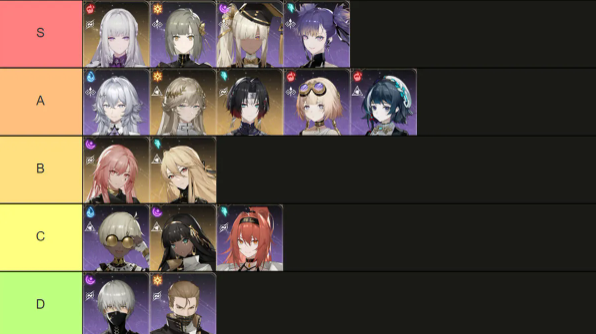
III. Black Beacon Tier List Overview
A. What S / A / B / C tiers mean (the “don’t get baited” explanation)
S-tier: top meta efficiency—strong kits, easy value, hard to replace
A-tier: excellent characters that do one or two jobs extremely well
B-tier: usable, often team-dependent, can feel great with the right setup
C-tier: niche picks, awkward kits, or characters that need too much to feel “normal”
And here’s the thing: tier lists aren’t about “who you’re allowed to play.”
They’re about who gives you the most power per resource.
B. Meta influences rankings (why the same character feels different month to month)
Meta changes when:
new characters shift team templates
balance changes tweak break values, damage windows, survivability
new content emphasizes shields, elites, or boss phases
So even if you’re reading this as an archive guide, remember:
Tier lists are snapshots, not commandments.
C. Priorities for new and mid-game players
If you’re building from scratch (or rebuilding in your head), your priority list should be:
One reliable main DPS
One strong Breaker
One sustain/support anchor
Flex slot for utility or extra damage
That’s the backbone that keeps your account from feeling “fragile.”
IV. S-Tier Characters (Best in Meta)
Most community tier lists around Black Beacon’s active period converged on a simple truth:
S-tier was small. The top slots weren’t crowded; they were claimed.
Below is the “why they’re S” breakdown in player language.
A. Florence — burst DPS and main carry potential
Florence is the kind of character that makes people say, “Oh… so this is what damage is supposed to feel like.” She’s often framed as a premier carry because she tends to combine:
high burst windows (delete phases, punish staggers)
clean rotation feel (you don’t fight your own kit)
strong scaling (investment pays off instead of plateauing early)
How you play her (practically):
You want to set up a window (breaker does breaker things, support makes it safe)
Then Florence cashes out with burst while the enemy is vulnerable
If you’re the type who likes numbers popping off when you do things correctly, Florence is basically that fantasy in character form.
B. Li Chi — top Thunder DPS and boss killer
Li Chi gets talked about like a specialist, but in a good way: boss-killing specialist is a real job in gacha ARPGs. A lot of lists point to Li Chi as a top Thunder damage option and a premier pick for hard targets.
What makes Li Chi feel great:
strong single-target pressure
good payoff when you maintain uptime
usually fits into “break → burst → repeat” team flow smoothly
If Florence feels like “burst queen,” Li Chi often feels like “consistent execution monster”—especially when the fight is basically one big enemy with a health bar the size of a novel.
C. Logos — premier Breaker and Light damage dealer
Every gacha with shields eventually teaches you a painful lesson:
a good Breaker makes your whole account feel better.
Logos gets called out a lot as a premier Breaker (and generally high-value character) because he helps you control fight tempo: break faster, open damage windows sooner, reduce the “why is this boss still shielded” frustration.
How Logos “wins” in practice:
Your DPS gets more uptime on vulnerable states
Your runs become more consistent
You can build teams more flexibly because Breaker quality is already solved
If you ever played content where the shield felt like the real boss, you already understand why Logos ends up S-tier.
D. Other “S-tier worthy” picks (when your roster is missing the big three)
Some lists keep S-tier strict (Logos / Li Chi / Florence), while others expand S-tier depending on patch feel and team templates.
Player advice here is simple: if you don’t have the “holy trinity,” you don’t panic—you build the best team spine you can with A-tier anchors.
V. A-Tier Characters (Strong and Flexible)
A-tier is where most accounts actually live. These characters can be incredible, and they’re often the reason “no reroll” players still clear content comfortably.
A. Viola — sub-DPS and debuff utility
Viola tends to land in that sweet spot: not always the top raw damage, but high team value. She’s the kind of character who makes your carry feel smarter because she brings utility that turns “good damage” into “clean damage.”
Where Viola shines:
secondary damage that isn’t dead weight
debuffs or utility that help bosses melt faster
flexible slotting into many team shells
B. Nanna — Breaker with strong damage-over-time flavor
Nanna gets positioned as a strong Breaker-style pick in many discussions, especially if you like a kit that keeps contributing while you reposition or rotate.
If you don’t have Logos, Nanna is the kind of character you build and think, “Okay, I can work with this.”
C. Ereshan — elite enemy specialist and dark DPS vibes
Ereshan is commonly treated as a strong A-tier option—especially for players who like dark-themed kits and want a DPS that feels good into tougher enemy profiles.
D. The “core supports and flex picks” crew
Depending on the list, you’ll see names like Zero, Asti, Hephae, Shamash, Ninsar, Ming, Azi, Xin mentioned as the backbone characters that fill real roles in real teams.
Here’s the player-friendly way to view them:
Zero / Asti: the “account glue” types—stabilizers, enablers, comfort picks
Hephae / Shamash / Ninsar / Ming: often the “budget core” that makes F2P teams functional
Azi / Xin: niche-leaning flex picks—sometimes valuable, sometimes awkward, depends on your roster direction
If you’ve played gacha long enough, you know exactly what this means:
You don’t need every character to be a carry. You need them to do their job.
VI. B- and C-Tier Characters (Niche but Usable)
Let’s be honest: B-tier and C-tier characters usually fall into three buckets:
They’re fine, but outclassed
They’re niche and require specific setups
They’re awkward until heavy investment (and then still “just okay”)
That doesn’t mean “never build them.” It means you build them with a purpose.
A. When to invest in lower-tier characters
Invest if:
you’re missing a key role (breaker/sustain) and they can fill it
they enable a synergy you actually use
you enjoy the character enough that “efficiency loss” is worth it
Don’t invest if:
you’re resource-poor and chasing a meta carry
you’re building them “just in case”
they overlap with a better unit you already own
B. Sample niche uses and budget team fits
Lower-tier units often function best as:
early progression filler
specific element coverage
utility patch (single mechanic you desperately need)
If you treat them like “temporary tools,” they’ll feel fine.
If you treat them like “future gods,” you’ll be disappointed.
C. Future-proofing: save resources vs. experiment
The safest approach is:
Build one main team to a solid baseline
Keep your “experimental builds” lightweight
Only hard invest when the team direction is clear
VII. Best Characters for Beginners
Even in an end-of-service context, this matters because it explains the roster logic that made accounts feel smooth.
A. Free story characters worth building
Many players recommended building the kind of “free/early” characters that provide real structure—names like Zero, Shamash, Ninsar, Asti show up often in beginner advice because they help you form a working team without banner luck.
B. Best starter DPS and supports for early game
Early game wants:
simple rotations
stable survivability
reliable break tools
So beginner-friendly builds usually look like:
one consistent DPS (even if not S-tier)
one breaker-ish unit
one sustain/support anchor
C. Safe investments if you don’t reroll
If you don’t reroll, your goal isn’t perfection—it’s momentum.
Build what you have into a functional loop: break → damage → survive → repeat.
VIII. Reroll Guide for Top Characters
Rerolling is always controversial. Some players love it, some players hate it, and some players do it once, get nothing, and swear off the concept forever.
A. Why rerolling mattered (during the game’s active life)
Because the top-end characters (especially premier DPS and Breakers) often gave you:
smoother clears
less resource waste
easier team building
And yes—guides frequently pointed to targets like Florence, Li Chi, and Logos as the dream outcomes.
B. Step-by-step reroll process (the general, non-hand-hold version)
Most rerolls follow the same skeleton:
Start fresh account
Speed-run tutorial and unlock summon access
Do initial pulls
Keep if you hit a top target; reset if you don’t
C. Ideal reroll outcomes (practical combos)
A “god start” was usually:
Logos + Florence (break solved + burst solved)
Logos + Li Chi (break solved + boss DPS solved)
Florence + Li Chi (damage solved, then you patch break with A-tier)
IX. Element-Based Character Recommendations
Rather than pretending element teams are mandatory, I’ll frame this the useful way: elements help you specialize once you already have a working team.
A. Best Light characters and teams
Light tends to be valued when:
it offers stable damage profiles
it pairs well with control/break windows
it supports consistent rotations
Logos being frequently highlighted as a top Light pick is part of why Light teams felt attractive.
B. Best Dark characters and erosion/DoT synergies
Dark kits commonly get positioned around:
sustained pressure
debuffs/erosion-like play patterns
punishing longer fights
If you enjoy “the boss is slowly losing the will to live,” dark-style teams are usually your vibe.
C. Best Fire, Thunder, and Water characters by role
A player way to approach this:
Thunder: often leans burst/boss deletion (Li Chi being a common highlight)
Fire: frequently leans damage + aggression (varies by roster)
Water: often leans sustain/control feel (varies by roster)
X. Role-Based Character Recommendations
This is the most useful section for most players because it doesn’t assume you pulled perfectly.
A. Best main DPS characters for bosses and story
Florence: burst carry profile
Li Chi: thunder boss-killer profile
Strong A-tier DPS like Ereshan / Viola can function as main DPS if needed
B. Best supports and healers for survivability and buffs
This is usually where “account comfort” lives. If a support keeps you alive and keeps your carry attacking, that’s value you feel every minute.
C. Best Breakers for shields and stagger mechanics
Logos is the premium example
Nanna is often referenced as a strong alternative
XI. Best Team Compositions by Stage
Because your team needs change as content changes, here are practical templates instead of “exact comps” (since exact comps depend on your roster).
A. Story progression and farming teams
Goal: clear fast, stay safe, don’t overthink.
Template:
Main DPS (Florence / Li Chi / strong A-tier DPS)
Breaker (Logos / Nanna / whoever you have that breaks reliably)
Sustain/Support (whoever keeps you alive + improves uptime)
B. Bossing and elite enemy setups
Goal: control the fight, break efficiently, maximize burst windows.
Template:
Boss DPS (Li Chi-style profile shines here)
Premium breaker (Logos-style profile is huge here)
Buff/sustain support (to keep your burst window clean)
C. Challenge/endgame team templates
Goal: consistency.
Template:
One carry you’ve invested deeply
One breaker you trust
One support who prevents “one mistake = wipe”
XII. F2P-Friendly and Low-Spender Teams
A. Free characters and easy-pull focused teams
Your best F2P advantage is not “having the strongest character.”
It’s not wasting resources.
Build the characters that:
fill roles cleanly
don’t require perfect gear to function
scale reasonably with normal play
B. Budget upgrades: which 5-stars to add first
If you only get one premium upgrade, most players would prioritize:
Breaker upgrade (because it improves every team)
Main DPS upgrade (because it shortens fights)
Luxury supports later
That’s why Logos-type value is so often emphasized.
C. Maximizing value from limited pulls
Rule of thumb:
Don’t chase too many “projects”
Finish one team first
Then branch out into specialization teams
XIII. Character Builds and Gear Basics
Because gear systems vary by game detail and patch history, I’m going to keep this grounded in universal ARPG-gacha building logic that players actually use:
A. Core stats and substats by role
Main DPS: damage stats first, then enough survivability to maintain uptime
Breaker: break efficiency + whatever keeps them alive long enough to do the job
Support: utility uptime (energy/skill cycling), survivability, and team amplification
B. Weapons/gear archetypes
DPS wants consistency (not just screenshot burst)
Supports want uptime and safety
Breakers want reliability under pressure
C. Common build mistakes
Overbuilding three DPS and wondering why you die
Ignoring breaker role and wondering why fights feel slow
Spreading resources across too many characters early
Chasing “perfect” instead of “functional”
XIV. Progression and Investment Priority
This is where most accounts either become smooth… or become a resource graveyard.
A. Who to level and ascend first
Your main DPS
Your breaker
Your support/sustain
If you try to level everything evenly, you end up with a whole roster of “almost good” characters—and that feels worse than having one strong team.
B. Balancing resources across core roles
A strong team is a stool with three legs:
damage
break/control
sustain/utility
Remove one leg and you’re on the floor.
C. When to swap mains
Swap mains when:
you pull a character that clearly outclasses your current carry
you have the support/break infrastructure to enable the new carry
your resources can actually finish the swap (half-built carries are pain)
XV. Frequently Asked Questions
A. Who are the best characters in Black Beacon right now?
During the game’s active period, many tier discussions repeatedly highlighted Florence, Li Chi, and Logos as top-end picks.
As of January 2026, the global version is no longer live, so “right now” is best interpreted as “in the final established meta period.”
B. Which characters should I build if I don’t have S-tier units?
Build a real team core:
best DPS you have
best breaker you have
best sustain/support you have
A-tier characters like Viola, Nanna, and Ereshan were commonly treated as strong enough to anchor teams.
C. Is rerolling necessary to clear content?
In most gacha ARPG structures, rerolling is a comfort/efficiency play, not a requirement. Strong fundamentals and correct role coverage usually beat “one lucky pull” if the team around that pull is a mess.
XVI. Future Updates and Meta Changes
For the global version: updates are no longer expected due to end of service.
For anyone studying the game as a design reference or revisiting old info, the useful takeaway is:
Meta changes always come from new characters, balance changes, and new content demands
Tier lists are always temporary truths
Smart players invest in roles and team structure, not just hype
If you’re looking for “updated tier lists” now, you’ll mostly find archived snapshots and community retrospectives rather than living meta tracking.
If you came here for a simple answer to “black beacon characters”, here’s the cleanest player-summary I can give:
There was never one single “mandatory” character, but a few names consistently rose to the top in community tier discussions—especially Florence (carry burst), Li Chi (boss DPS), and Logos (premium breaker value).
Your account strength wasn’t just “who you pulled.” It was whether your team had all the roles covered: DPS, breaker, support/sustain.
A-tier was the real workhorse tier—the characters that made non-perfect accounts feel stable and fun.
And for anyone reading this in January 2026, remember the critical context: Black Beacon global service ended, so this guide is best used as an archive roster breakdown and team-building reference.
If you want, I can also write a companion piece in the same tone that focuses purely on “best team comps using only the most commonly owned characters” (the kind of guide that assumes average luck, not dream pulls).